diffpy.cmi
Diffpy.cmi is designed as an extensible complex modeling infrastructure. Users and developers can readily integrate novel data types and constraints into custom workflows. While widely used for advanced analysis of structural data, the framework is general and can be applied to any problem where model parameters are refined to fit calculated quantities to data.
Diffpy.cmi is a community-driven project that supports Unix, Linux, macOS, and Windows platforms. It is designed to be used in Python scripts enabling flexible scripting and automation for advanced and reproducible workflows. Users are encouraged to leverage the software for their modeling needs and to contribute feedback, use cases, and extensions through the project community.
Installation
For the most up-to-date installation instructions, please refer to the installation section of the diffpy.cmi README page on GitHub.
Pack and Profile Installation
Diffpy.cmi is designed to be modular and extensible through the use of optional dependencies known as packs. Additionally, users can define custom workflows that combine multiple packs with optional post-installation steps, known as profiles.
For more information on packs and profiles please refer to the diffpy.cmi overview page.
For information how to install packs and profiles, please refer to the diffpy.cmi command-line interface page.
Tutorials
Many examples exist for diffpy.cmi. Using the command-line interface (CLI), these examples can be copied directly to your computer. For information on how to use the command-line interface to access the examples, please refer to the diffpy.cmi CLI documentation. Additionally, here are some direct links to other tutorials and examples,
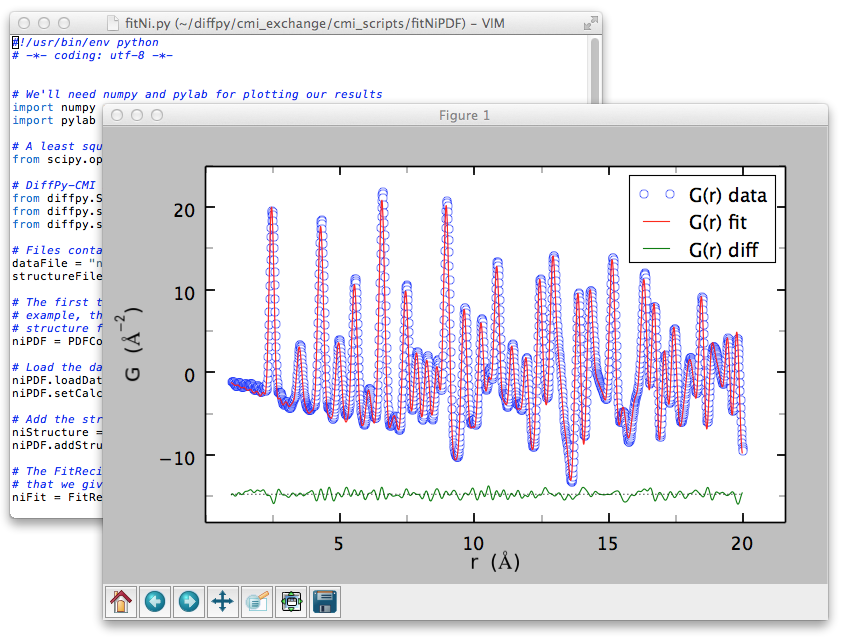
A step-by-step tutorial on using diffpy.cmi to fit a nickel PDF.
Examples and experimental data from the book Atomic Pair Distribution Function Analysis: A Primer are freely available at our GitHub repository.
Worked examples from ADD2019 school and conference – https://github.com/diffpy/add2019-diffpy-cmi.
Documentation
Documentation for diffpy.cmi is available at https://www.diffpy.org/diffpy.cmi.
Reference
If you use this software in a research work which leads to publication, we ask you to acknowledge the use of diffpy.cmi by citing the following paper:
P. Juhás, C. L. Farrow, X. Yang, K. R. Knox and S. J. L. Billinge, Complex modeling: a strategy and software program for combining multiple information sources to solve ill posed structure and nanostructure inverse problems, Acta Crystallogr. A 71, 562-568 (2015).
